Skincare · 5 min read
Copper peptides explained: what is GHK-Cu?
Understand the copper peptide behind the name, the difference between laboratory research and human results, and the questions worth asking before choosing a serum.
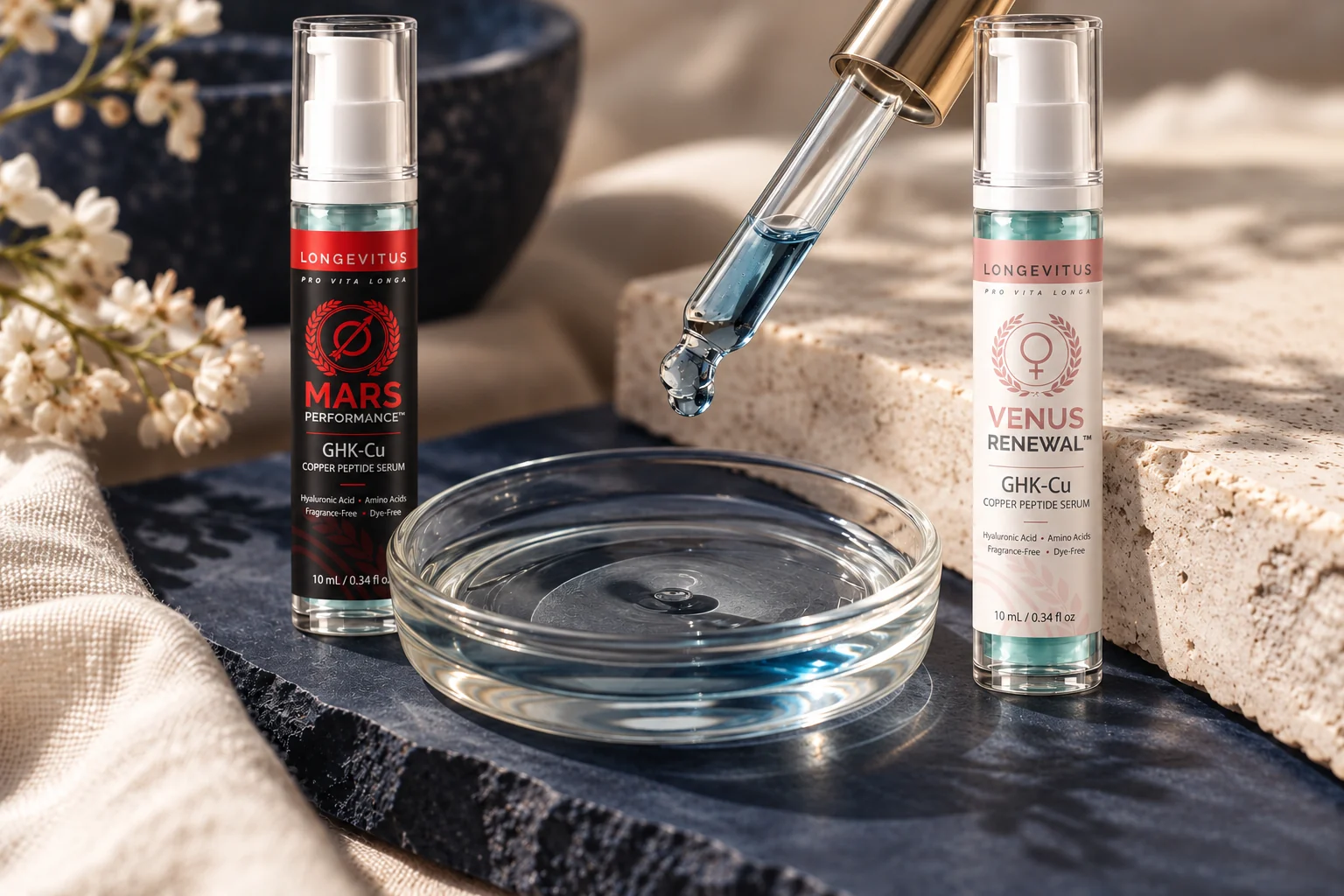
GHK-Cu is a complex formed when the small peptide GHK binds copper. It is an interesting skincare ingredient with a long research history, but the presence of its name on a bottle does not establish a particular result for the finished serum.
If you have been searching for “copper peptides for skin,” the useful next step is to separate three things: what the molecule is, what researchers have studied, and what a specific product can show.
What the letters mean
GHK refers to a chain of three amino acids: glycine, histidine and lysine. “Cu” is the chemical symbol for copper. Researchers isolated GHK from human plasma and studied its affinity for copper. A foundational experiment reported that GHK-Cu stimulated collagen synthesis in cultured fibroblasts, cells involved in connective tissue. This was a laboratory cell study, rather than a trial of a face serum. Read the original fibroblast study.
That finding helps explain why scientists became interested in the ingredient. It cannot tell a shopper how much a commercial serum will change their skin, how quickly a difference might appear, or whether the formula will feel comfortable.
The setting of a study matters
Early research also investigated GHK-Cu in experimental wound models. In a rat study, researchers delivered the complex into implanted wound chambers and measured changes in tissue components. That is a very different setting from applying a cosmetic product to intact facial skin. Read the original animal study.
An online summary can lose these details and leave only a phrase such as “increased collagen.” Keeping the method attached to the finding makes the evidence easier to understand. Animal work can generate a worthwhile scientific question without answering the everyday cosmetic question.
A serum listing should also be assessed for its intended cosmetic use. Research involving wounds is not a reason to use a cosmetic serum as a wound treatment or after a procedure without the clinician's guidance.
What has been tested in people?
One small randomized study examined skin regimens containing GHK-Cu after carbon dioxide laser resurfacing. Thirteen patients completed the study. The researchers did not find significant differences between groups in their objective assessments of wrinkles or overall skin quality, although patient-reported improvement in overall skin quality favoured the GHK-Cu group. The procedure and small sample limit how broadly the findings apply. Read the original human trial.
This does not settle every question about copper peptides. It does show why a balanced guide should report the measured result rather than extracting only the most favourable sentence.
A strong product claim would ideally be supported by a study of the finished formulation, with a suitable comparison group, clear outcomes and enough participants to make the result useful. Evidence for another product, another delivery method or the ingredient in isolation is a separate piece of the picture.
How to read a copper-peptide product page
Look for the complete ingredient list, directions, size and intended use. If a page offers a clinical number, ask what was tested and where the study can be read. Was the number an average result or the best response? Was there a comparison formula? Were participants using other products or receiving a procedure?
You do not need to become a scientist to ask these questions. They help turn an exciting ingredient name into an informed purchase.
Health Canada says cosmetic advertising should be accurate and distinguishes appearance claims from therapeutic claims. A skincare serum is not automatically a treatment for a disease or a product that has been proven to modify body functions. Health Canada's cosmetic claims guidance.
Where Longevitus fits
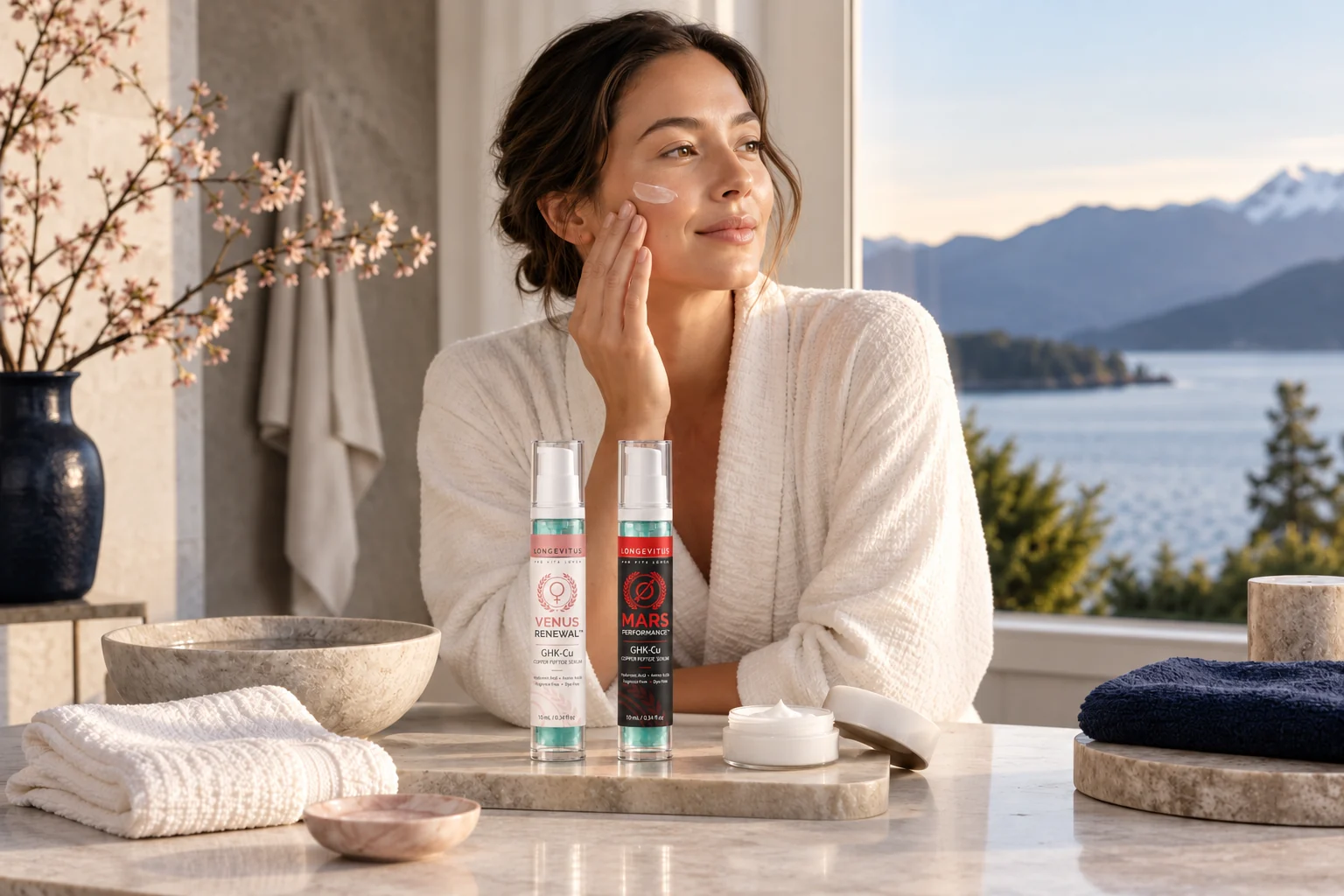
VENUS Renewal GHK-Cu Serum and MARS Performance GHK-Cu Serum are currently listed at $79.95 CAD each, in 10 mL pump bottles. The Mars listing includes Copper Tripeptide-1 in its ingredient list. The individual product pages and packaging are the place to check current formulation details and directions.
The studies discussed here are ingredient and research background. They are not clinical trials of these Longevitus products, and they do not establish identical outcomes for them. The Venus and Mars collection names also do not establish that your skin needs a particular peptide because of your gender; see how to choose skincare for men and women.
If you decide to explore a copper-peptide serum, give it a defined place in a simple routine. Avoid changing several products at once, follow the packaging, and use our serum introduction and layering guide. For the wider picture, what actually works for skin aging explains why sun protection and basic care still deserve priority.
Practical questions
Are all peptides interchangeable?
No. A study names a particular molecule for a reason. GHK-Cu, an unrelated peptide and a mixture of several ingredients are different research subjects. A product carrying the broad word “peptides” cannot borrow every finding reported for the category.
Does seeing Copper Tripeptide-1 tell me the concentration?
It identifies an ingredient on a list, but does not by itself establish its percentage or the formula's performance. The Mars product page currently names that ingredient; it does not provide a percentage. Ask for product-specific information if concentration is central to your decision, and avoid filling the gap with a number found on another brand's page.
How can I make a personal trial more useful?
Keep the surrounding routine steady, use the serum as directed and decide beforehand what you will observe. Comfort, texture and visible appearance can be tracked separately. Take comparison photographs in similar conditions if you find them useful, and do not treat an ordinary fluctuation as proof of a biological mechanism.
Should I choose copper peptides because the research sounds complex?
Complexity is not a personal benefit on its own. A good choice can be explained simply: you understand the product's intended use, its details are clear, it fits your routine and its claims are proportionate to the evidence.
Sources & further reading
- Stimulation of collagen synthesis in fibroblast cultures by GHK-Cu
Original laboratory study; supports molecular description and cell findings only.
- GHK-Cu in rat experimental wounds
Original animal study; explicitly distinguished from topical cosmetic use.
- Effects of topical copper tripeptide complex on CO2 laser-resurfaced skin
Small randomized human study; objective findings and patient report both described.
- Cosmetic advertising, labelling and ingredients — Health Canada
Cosmetic-versus-therapeutic claim boundary.
- VENUS Renewal GHK-Cu Serum — Longevitus
Live name, price and 10 mL format checked 2026-10-02; no formula extrapolation.
- MARS Performance GHK-Cu Serum — Longevitus
Live name, price, size and Copper Tripeptide-1 ingredient listing checked 2026-10-02.
This article is published by Longevitus for education. Research about an ingredient does not establish that a Longevitus product has the same effects. Product ingredients, directions and current availability belong on the product page. For personal medical or treatment questions, consult a qualified health professional.